Published 2026-11-03 · Progetto Shades Journal
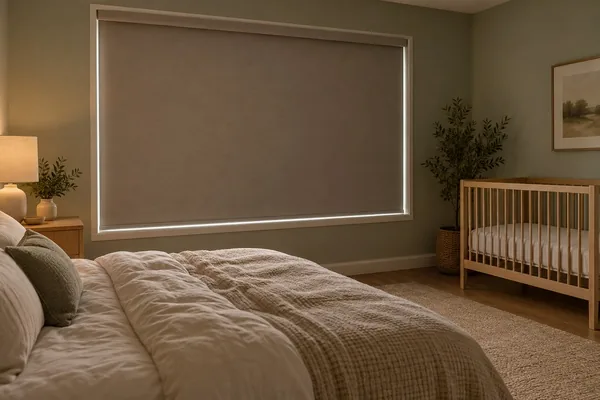
What makes blackout shades actually block light?
Summer sunrise in Poway comes before 6 a.m., and the afternoon sun is strong enough to wake a napping baby through ordinary shades. Blackout shades fix that, but only when three things work together: the right fabric, a mount that fits the window, and edges that leave no gaps for light to slip through.
Progetto Shades fits blackout window coverings for Poway families who are done with 5:45 wake-ups and short naps. To get help with your rooms, reach out to our team or call (858) 338-1678.
The fabric has to be fully opaque, usually a woven material with a blackout backing or a coated layer that stops light completely. "Room darkening" fabric is not the same thing; it dims a room but still glows when the sun hits it.
That difference matters more in Poway than on the coast. Inland, the marine layer burns off early or never shows up, so a bedroom facing east toward Lake Poway can catch full sun soon after dawn. A shade that only softens light will turn amber and bright long before anyone wants to be awake.
Check the fabric itself, not just the color. Some dark fabrics let light through the weave, while some light colors with a proper backing block it entirely. Hold a sample up to a window on a sunny afternoon and you will see the difference right away.
We carry blackout fabrics in roller, cellular and Roman styles, so you do not have to give up the look you want to get a dark room. You can see the styles on our window shades page.
Cellular is worth a thought in Poway specifically. The honeycomb traps a layer of still air against the glass, so a blackout cellular shade darkens the room and buffers the heat at the same time. On a west facing bedroom in August that second job matters nearly as much as the first.
Why do blackout shades still leave light gaps, and how do you stop them?
Most leaks come from around the shade, not through it. Light slips past the sides, over the top and under the bottom rail, and the fix is side channels, a careful mount choice and sometimes a second layer.
A tired-looking parent once showed us photos of the nursery where her six-month-old slept. A line of afternoon sun streamed right across the crib and often cut naptime short. Darker fabric hadn't solved it, which usually means the light is getting around the shade rather than through it. We sat down and talked through her options.
Inside mount shades sit within the frame and look clean, but they need a small clearance on each side, and that clearance is a light gap. Side channels close it by running a track down each edge. Outside mounts cover the frame and overlap the wall, which blocks more light on windows with shallow frames, common in older Poway homes near Old Poway Park.
For the darkest possible room, layer a shade with blackout curtains that extend past the frame on both sides.
What are the safest blackout options for nurseries and kids' rooms?
Cordless and motorized shades are the safest choices for any room a child sleeps or plays in. With no dangling cords or loops, there is nothing for a curious toddler to pull on or get tangled in.
Cordless shades raise and lower with a gentle push on the bottom rail. They are simple, they hold their position, and they cost less than motorized systems. For most kids' rooms, they are the right balance of safety and budget.
Motorized shades go a step further. You can lower the nursery shade from the hallway without opening the door, or set it to close before afternoon nap and open at a set wake time. In homes facing west toward Mount Woodson, where late sun pours into bedrooms, a schedule takes one more thing off a busy parent's list.
Whatever you choose, keep the crib away from the window and check that every shade in the room is cordless, including older ones you inherited with the house. Swapping a single corded blind is a quick fix and worth doing before the baby starts pulling up on furniture.
Why does professional measuring matter for a gap-free blackout fit?
Because blackout performance lives in fractions of an inch. A shade ordered a little too narrow leaves a bright stripe on each side, and one too wide will not fit the frame at all.
Window frames are rarely perfectly square, especially in homes that have settled over a few decades. We measure each opening at the top, middle and bottom, check the depth for an inside mount, and decide where side channels or an outside mount will give the darkest result.
We also look at how the room is used. A nursery that needs naps at 1 p.m. is a different problem than a bedroom for a parent who works nights. That conversation shapes which fabric, mount and operation we recommend, so you buy once and the room stays dark.
If early sunrises or afternoon glare are costing your family sleep, book a consultation for a fitted, gap-free installation. Prefer to ask a few questions first? Contact Progetto Shades at (858) 338-1678.