Published 2026-11-06 · Progetto Shades Journal
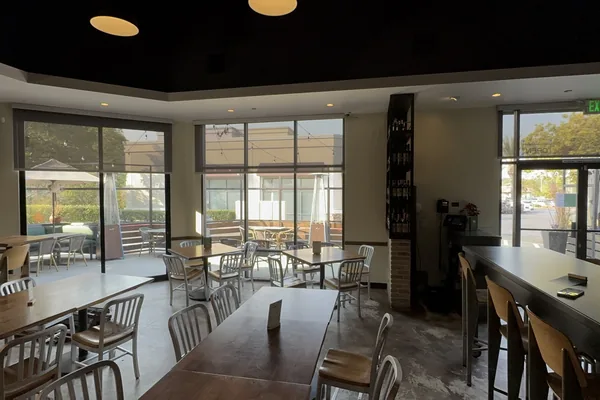
Do you install commercial window treatments in San Diego?
Plenty of companies in this trade treat commercial as the thing they fit in between houses. We are going the other way with it on purpose.
Progetto Shades handles commercial projects across San Diego County alongside our residential work. If you have a space that needs covering, talk with our team or call (858) 338-1678.
Yes, and we want more of it. We have run solar shades and blinds through a cafe and its back office in Del Mar, motorized roller shades across a Poway office suite covering the conference room, the private offices and the waiting area, and blackout drapery with sheers in hotel guest rooms in Escondido.
Those three jobs cover most of what commercial means in practice. Workplaces where people stare at screens all day, hospitality where the public sees the room, and guest accommodation where one specification gets repeated across dozens of identical windows.
There is no minimum order on commercial any more than residential. A single conference room with a glare problem is a job worth doing, and it is often how a longer relationship with a building starts.
The real difference is not the product. It is that your business has to keep running while we work, and almost every decision follows from that.
What do offices actually need from window treatments?
Glare control, not darkness. That sounds obvious and it is the thing most office installs get wrong.
A workplace needs daylight. People work better in it, and blacking out a floor to fix one bright window is a bad trade. Solar shades in a 3% or 5% openness cut the glare off monitors while the room stays bright and the view survives, which is what you want at a desk.
Conference rooms are the exception and deserve their own thinking. The moment a screen goes on, or a video call starts and everyone is backlit into silhouette, you need more control than a single solar shade gives. We usually specify a dual layer there: solar for daily use, a room darkening shade behind it for presentations.
Orientation should drive the spec rather than uniformity. The west elevation of a building has a completely different problem from the north one, and fitting the same fabric everywhere means over-treating half the floor and under-treating the rest. We zone it by exposure.
Motorization earns its place faster in an office than a house. Nobody is going to walk a floor adjusting fourteen shades twice a day, so in practice manual shades in a workplace get set once and left, which defeats the point of buying them. Budget roughly $150 to $200 per window for a motor, and consider scheduling them to drop before the afternoon sun arrives. The lines we fit are in our motorized range.
What changes on a cafe, restaurant or hotel job?
Two things: the hours you can work, and how hard the finished product has to wear.
Hospitality spaces are occupied when everyone else is free, so installation happens early, late or on a closed day. We plan around service rather than asking a restaurant to lose a lunch. On the Del Mar cafe the entry doors and the corner windows were the priority, because that is where the afternoon sun was landing on diners and on the counter.
Durability matters more than in a house. A public room gets touched constantly, cleaned aggressively and knocked by furniture, so we steer toward materials that take a commercial cleaning routine without the finish coming off. The same goes for the mechanism: a chain that gets yanked forty times a day is not the same duty cycle as a bedroom shade.
Hotels are a different problem again, and the Escondido guest rooms are a good example. Each room needed sheers for the day and blackout for the night on one window wall, which is the standard hospitality answer, and it has to be identical in every room. Consistency is the whole specification.
Replaceability matters there too. In a guest room something will get damaged eventually, so the right choice is a product line that will still be available in three years, fitted so one panel can be swapped without redoing the wall. You can see the fabric families we work with in the full catalog.
How does a commercial project run?
It starts with a walkthrough rather than a quote, because the building usually sets more of the constraints than the windows do.
We look at orientation, what is on the walls, how the space is used through the day, and who needs to approve the result. On a leased space that often means the landlord as well as you, and on a multi-tenant building it means a property manager with rules about what is visible from the street.
Paperwork comes next and it is worth sorting early. Most commercial buildings want a certificate of insurance from the contractor before anyone works on site, plus agreed working hours and, in a tower, a booked service elevator. We carry the insurance and handle that coordination directly with building management.
Lead times match the residential ones, since it is the same manufacturing: two to three weeks for shades, about four for drapery, five to six for shutters and exterior shading. Installation is where commercial differs, because it is often phased across several short visits outside business hours rather than one long day.
Phasing also helps the budget. Doing the west elevation and the conference room first, then the rest of the floor next quarter, is a normal way to run these and we will keep your specification on file so phase two matches phase one exactly.
If you have a space with a glare problem, a room nobody can present in, or a fit-out coming up, book a walkthrough and we will tell you what it needs before quoting anything.