Published 2026-10-26 · Progetto Shades Journal
Are motorized shades worth it for ocean-facing windows in La Jolla?
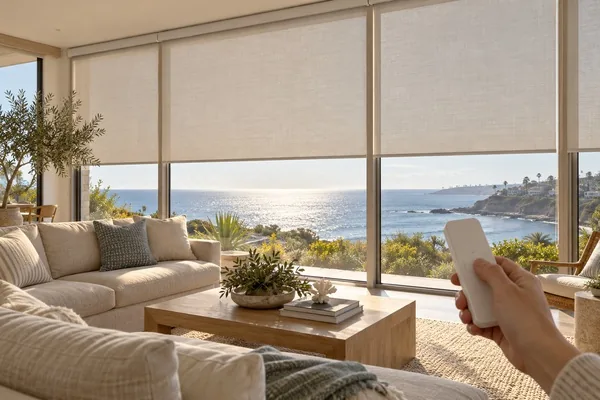
If your living room faces the Pacific, you already know the trade. You get the view, and you also get the 4 p.m. glare that bleaches the sofa and turns the TV into a mirror. Motorized shades fix that without anyone climbing on furniture or tugging cords on a ten-foot window.
Progetto Shades fits motorized systems in La Jolla homes ranging from beach cottages to hillside view houses. If you are weighing it for your own windows, reach out to our team or call (858) 338-1678, and we will walk you through what makes sense room by room.
For most west-facing coastal homes, yes. Motorized shades let you control harsh afternoon light and UV on large glass with one tap, which protects floors and furnishings and makes oversized windows comfortable to live with.
Coastal light here behaves differently. Mornings often start under a marine layer, especially in May and June. Then the sky clears and the afternoon sun comes in low off the water. A home above La Jolla Shores can go from soft gray light to direct glare in about an hour.
That low sun is the real problem. It reaches deep into a room, past the roof overhang, onto hardwood, rugs and upholstery. Over a few summers it fades fabric and dries out wood finishes. A shade that lowers itself on time protects your furniture far better than one you mean to close and forget.
You also keep the view. A solar screen or light-filtering fabric cuts the glare while the horizon stays visible, so comfort and the ocean stop competing. Our motorized shades come in fabrics from sheer screen to full blackout, and we usually suggest a different openness for the living room than for the bedroom.
Should you choose hardwired or battery motorized shades?
Choose hardwired if you are building or remodeling and can run power to the window heads. Choose rechargeable battery motors if your walls are finished and you would rather not open drywall or plaster.
Hardwired motors run quietly on large, heavy shades, and you never think about charging. The catch is the wiring. Running power to every window is simple in a new build or a gut remodel. In a finished home with plaster walls, which describes plenty of older houses in Bird Rock, it gets expensive and messy.
Rechargeable motors have improved a lot. Most households top them up only a few times a year, depending on shade size and how often they move, and some systems take a small solar panel tucked behind the shade. For a retrofit on finished walls, battery power is usually the cleaner choice.
Plenty of homes end up with both. We might hardwire the big slider wall in the great room during a remodel, then use battery motors in the bedrooms where nobody wants new holes in the ceiling. You can compare the full range of motorized shade options before we visit.
How do smart scheduling and voice control handle afternoon glare?
You set the shades to lower on a schedule or by sun position, so they drop before the glare hits and rise again after sunset. Voice commands and a phone app handle everything in between.
Scheduling is where motorized shades earn their keep. Instead of reacting at 3:30 when the room is already warm, the west-facing shades come down partway on their own each afternoon. Many systems follow local sunrise and sunset times, so the schedule shifts with the seasons and you never reprogram it.
Privacy works the same way. Homes on the slopes of Mount Soledad often have big windows facing the street or a neighbor below, and at night a lit room becomes a display case. An evening scene can close the street-side shades at dusk while leaving the ocean side open.
Most motors connect to the popular voice assistants and home hubs, though compatibility depends on the motor brand, so we confirm it against your setup before ordering. Done right, the house handles the light quietly and the same way every day, and you stop thinking about it.
Why do oversized and hard-to-reach windows need professional installation?
Large and high windows leave almost no margin for error. A shade a quarter inch off can rub the frame or hang crooked, and a heavy motorized roller needs solid mounting that holds for years in salty coastal air.
Ocean-view homes tend to have exactly the windows that are hardest to fit: floor-to-ceiling panels, clerestories, corner glass and stacked transoms. We measure every opening ourselves, check whether the frame is square, and plan where each motor and wire goes before anything is ordered.
Hard-to-reach windows are where motorization changes daily life most. One of our customers, who was getting on in years, wanted a better way to close her shades. She had been keeping a step stool behind the sofa just to reach her window coverings, and she was tired of it. That is precisely the problem a motorized shade solves: a button takes the place of the stool.
The right system depends on your windows, your wiring and how you use each room. Book an in-home consultation and a specialist will measure, look at the light in your house and quote the right setup. Prefer to talk first? Contact Progetto Shades at (858) 338-1678.